
2026-04-01 21:41
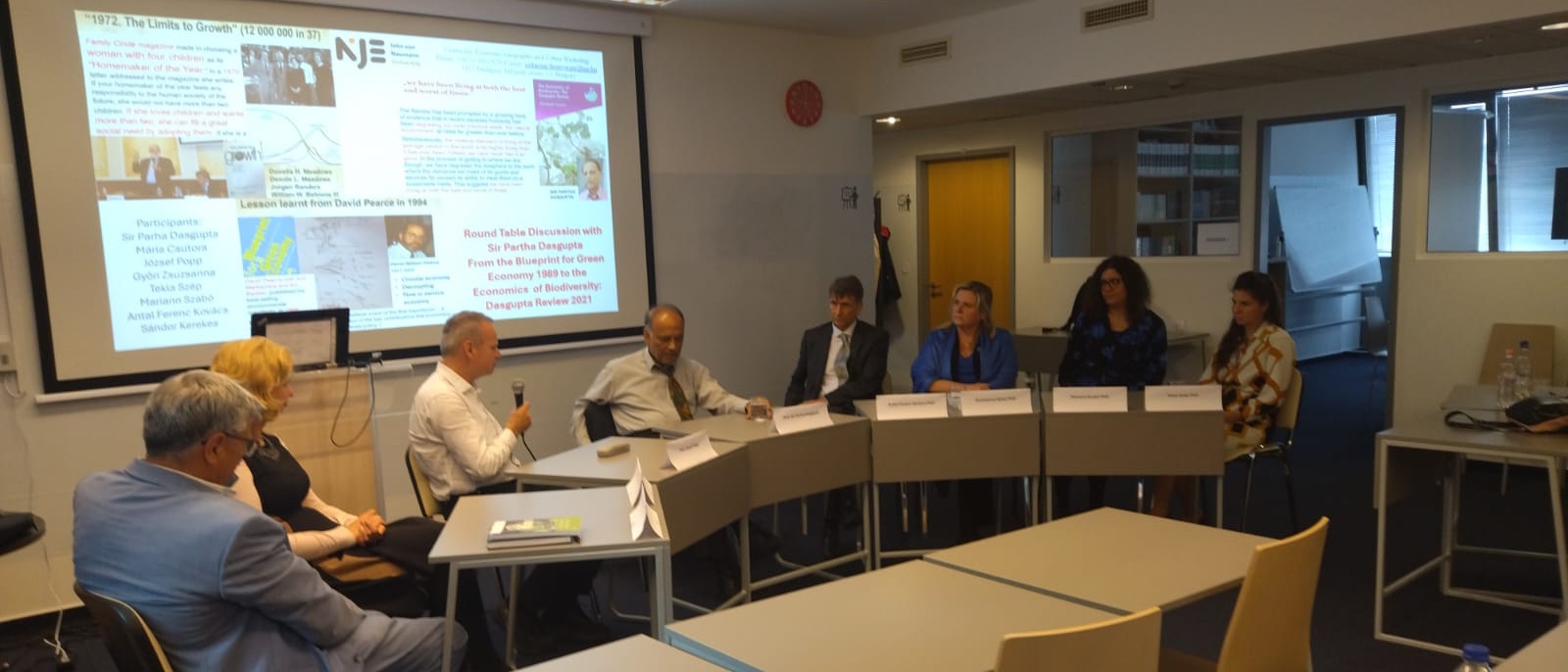
On May 8, 2025, a roundtable discussion was held at John von Neumann University’s Centre for Economic Geography and Urban Marketing in Budapest’s Infopark. The event brought together program leaders in Regional and Environmental Economics MA from several Hungarian universities to present the current state of their curricula. The highlight of the program was a guest lecture by Professor Dasgupta, which drew significant interest from both the University’s Doctoral School and MA students.
Background
Sir Partha Dasgupta is a world-renowned Indian British economist, professor emeritus at the University of Cambridge, and a fellow of St John’s College. His areas of expertise include ecological and environmental economics, as well as development economics. His landmark synthesis of sustainability knowledge, The Economics of Biodiversity: The Dasgupta Review, was published in 2021. Professor Dasgupta came to Budapest at the invitation of Pázmány Péter Catholic University to attend and deliver a keynote lecture at the conference on the occasion of the publication of the Hungarian translation of the Dasgupta Review. On this occasion, Professor Dasgupta visited the Economic Geography and Urban Marketing Centre, attended a roundtable discussion, and delivered a lecture, summarizing his thoughts on the interrelations between nature and economic growth.
The lecture
Well … I can be relatively brief, because what we're discussing here doesn't really exist. So, try and find serious discussion of natural capital in an economics textbook and you won't find it. It's not there. So, I want to discuss how I see the way economics graduate textbooks could be written. Look at the entire history of growth and development economics and the economics of poverty. These two big branches of work I'm talking about now macroeconomic models or macroeconomic settings in which these issues are discussed. They were developed in the late '50s, mid-'50s, Solow’s paper in 1956 Arthur Lewis' paper on the dual economy. I can't remember when it was published, but anyway it's sort of late '50s onwards. They have in some sense shaped much of what goes on. And I think it is important for us to realize how so much of research is path dependent. You work on the last person's paper, and you tweak it and that's fine. That's exactly how science normally grows and that's okay. But here it's not so okay because if a major item is missing, then playing around with exact existing models essentially keeps that thing missed, so to speak. And that is the trouble with growth and development economics. Let us say endogenous growth marvels and so forth which have so much influenced our picture of future possibilities or economic possibilities in the future. And they influence policy. Of course, they influence policy because today's decision makers are yesterday's graduate students. It's sort of the mutual feedback between graduate students today, professors the next year, decision makers the following year and so forth. It's just that relationship is very strong, powerful and enduring.
So, it (discussion on natural capital in economics textbooks) remains missing. You don't see the dominant models of growth and development having any, they talk greatly about endogeneity of growth for example, very rich literature on that. But in all this what is missing is natural capital. Of course there's always a counterexample to anything that you say. One counterexample is the fact that in my review there's a whole chapter on how to develop macroeconomic models with natural capital built in such a way that you have to reconstruct the ideas of growth and development. And I'll come back to that in a few minutes before I conclude my remarks. But broadly speaking, it is missing. And when the environmental issues are raised, they're introduced as sort of add-ons. And in such a way that they can be removed when they're not needed, put back in when they are needed, because you want to make a point. And if you look at the models, you will see what I mean by that.
In particular I mean the fact that since we are talking about technical things, take an aggregate production function. Outputs are a function of produced capital, human capital. And if you are particularly interested in natural resources, you will put in as an inflow of harvested natural capital, say exhaustible resource or something. Some flow that you introduce into the production system. And then you have a dynamical equation of the usual accumulation equation goes out, say, of produced capital taken from growth models. But then you will have also a model of the accumulation or regeneration of the natural capital stock. If it's exhaustible resources, you will simply say the stock declines at the rate at which you extract. If it's renewable resources, then you will have a natural renewable process. Now even that, by the way, is missing usually. What I'm now already sketching out for you is missing. However, what I think makes for our subject so interesting is not the introduction of a flow of input into the production function, but the fact that the production function itself, there's a scale factor which depends on natural capital.
The scale factor meaning the ambient atmosphere if nothing else. The climate system. Now these are global public goods, and one way of modelling global public good is to have it as a scale factor in the production function because it affects everything else. Double the increased temperature by one degree and the whole production mechanism faces problems at every level as it were. So it's possible to model it, but I haven't seen estimates of this anywhere in the literature. In my review of the economics of biodiversity, which came out in 2021, there are two-star chapters: 4* star and 13*. They technical chapters. They lay out macroeconomic models which are the backbone of the informal discussion in the main chapters. And in chapter 4 I sketch out exactly the kind of thing that I'm talking about now. The feedback from output to the effect on the natural environment and back to the ability of the output to be produced if it's a deleterious effect on the environment and so forth. So, it's all this is possible to model. And as I say, you can write on the consistent story of, I wouldn't say growth and development economics, simply economic possibilities in the future. You would preclude indefinite growth because the feedback is going to shrink the scope of the production by the scale factor. That's the way to think about it. It's not a difficult issue to model. Why do I think it's important to have models in which indefinite growth is not a possibility. And the reason I think it is important: right at the beginning to keep that in mind is that all production requires inputs from nature. The whole of the entire human system is embedded in nature. So, it's a truism that goes that saying.
Now if you thought that indefinite growth of output was possible. Then certain consequences following from your assumption about what you think are economically viable. You have a finite earth, so the flow of services that Mother Nature offers us, what I was taught in my earliest talk this morning. I was following the literature, maintenance and regulating services. That is a final bound. They are not going to be, you can't raise the flow of maintenance and regulating services from nature. What you can do is to try and substitute your way out of the fact that they may bound it, by being clever. And of course, we economists have a very, it's like magician pulls out of a hat, saying if you're in trouble, ingenuity, technological progress. So, let's carry that through. I'm a believer in technological progress too. I'm a believer in human ingenuity as well as anybody else is. Let's suppose the incentives are right so that we actually use our ingenuity in the right direction, economize on nature rather than create more chainsaws. So, okay. Then, because the flow of services is finite, because the biosphere is finite. Indefinite growth must mean of output. Must mean that per unit of output the resource base on which the natures – let's call it the resource base, although it may be maintenance and regulating services only – on which output depends, must be shrinking as output rises. Because the base is finite, and output rises, the amount of resources or nature services required for a unit of output must be declining. And if you have indefinite growth of output, it must mean that you're anticipating that (input from nature) to go to zero in the long run. The ratio, because one is fine, the other is infinite, okay? That in turn means what? You might say well human ingenuity, but human ingenuity here means that in the limit you will be, you'll fly away from nature. You won't need nature at all at the margin. At the margin. Any further increase will require zero vanishingly small dependence on that. Which is another way of saying that we are external to nature. The human economy can through ingenuity escape from nature. Now, Elon Musk will say yes, we can do that:
We just fly off to another planet. That's the idea.
That is, that conception is consistent with the idea that we can escape. So, to bear in mind that we are looking at a problem in which the presumption is… that you have indefinite growth in your growth model. Yes, we do have natural resources in, we just tweak it, but we can still have. Then, the implication is that in the limit you will free yourself of nature. Okay?
So, if you believe that, then you can continue doing this. But the question is does one believe? Now if you press growth theorists – by the way, I should tell you one thing which is a pure personal anecdote, but it's a deeply felt personal anecdote, because it means a lot to me. I've known late Robert Solow since I was a graduate student. And I think we looked at economies very differently, particularly as the years folded. But he was very fond of me. Of course, I used to regard him as one of the aces of our subject. And gradually as he grew older and I have letters from him so that, you know, when I die my letters are published, the correspondence they will show up. He became increasingly moving towards the limitations I saw in his model. But that's not a criticism. That was 1956 for God's sake. And the global economy was very small in those days relative to what it is now. So, as an approximation it wasn't a bad one. I would never criticize Solo. But I would criticize this persistent belief that you can keep natural capital out.
It was the latter half, the last 20 years or so, I could see he was moving more and more towards, because he hated writing, as the number of published papers that Robert Solow wrote is vanishingly small relative to his influence on the profession. And good influence, he was a great teacher, one of the greatest teachers in the economics ever. And the last few letters he wrote to me, three, four, five years, he would always end, saying: give but love to Carol and enjoy the flowers so long as they are there. So, this is his way of telling me that, you know, you're on the right track and that meant a lot to me, of course. So that's sort of the background. The background is that the growth and development economics that we have been raised on and the economics of policy are not fit for purpose. They may have been fit for purpose when they were devised in the mid-50s. But, as I was arguing this morning, if you look at the size of economic activity as measured by global GDP and you plot it across time then you will see a sharp rise from a relatively low level, relative to what is now, in about 1950, in the post-war period. Very sharp rise just like the hockey stick that you see when you plot emissions. Similar thing, not accidentally because they are correlated. Emissions are correlated with economic activity. You see the same thing. So, what am I getting out of it? I'm getting out of the fact that, I think, we shouldn't waste our time criticizing the early growth models because they were reasonable approximations of the time that they were constructed. But they're not fit for purpose now. And until very recently, I don't read the Journal of Economic Growth. There is a journal of economic growth which I don't read, not because I don't read, I just don't read many journals anyway. But the idea of technological progress overcoming these resource constraints, nature's constraints, is I think now has to be dismissed. There is a counter argument which is say, I mean one of my, several of my friends in the growth field say: well, look Parthenon, look we're not talking about indefinite growth. We're talking about, say for the next 100 years or so. So, we can have a marriage of convenience here as it were, understanding if not convenient. To which I would say that's not a good answer, because at the moment we can't worry about the long term even if it's 100 years, because even as we speak, we are overreached nature. The ratio of the demands we make on the biosphere and the biosphere's ability to supply what we are demanding on a sustainable basis, I mean provisioning goods are the kind that I was mentioning this morning. That's about 1.7 now. And that's an underestimate because it doesn't take into account the extinction rates of species and the option values of species. If you take those into account, then you need to give them more birth than we currently do. Well, if we're already overstretched then we can't say: „well, Louis, let's keep on over-stretching for another 70 years that's going to make life good”, because crashes can come, all sorts of possibilities. So, it's not as though we are starting from slack and then recognize that we'll come to a limit and then we ought to be sacking. We've already beyond the slack. There is no slack. We are actually overdoing it. So, now one has to make a decision, as to somehow or the other we economist… So, we have to make some kind of a decision as to how to think about the fact that the human economy is embedded in nature. How to model that. Now, I think it can be done and chapter 4* (of the Dasgupta Review), I tried to do that. He will find the embeddedness through the scale function. That's a scale factor in production. So, I'm using very standard modelling devices so that it's not something out of the blue. I haven't got the imagination to create a new economic system. I'm using perturbing existing models to see how much I can accommodate the kinds of concerns that we have. And, if you put this in the scale factor of the production function, so I recognize that there is feedback. And if that goes down, you can try and substitute your way inside the production function, but if the scale factor keeps on going down, you have a problem. That's total factor productivity, I guess, is what I'm talking about. That's the scale factor. So, that's how I see these issues, and I think economics textbooks can be made wildly exciting if we bring these things into with simple perturbations to these modelling devices. Because it would give the young people something literally novel for them, particularly in economics where this doesn't exist. So, it's not a question of just having yet another factor of production. That's how it's usually treated. There's feedback through the scale factor which is one way of showing that the human economy is embedded in nature and that's the right way of doing it. I think there are the chapter 4* in my review, I don't think (it) has been read much, because I haven't seen any, you know, people working on them to estimate the production functions and so forth…Which is, you know, the standard things that one does with these aggregate models. But I think that needs to be - it should be – done, because otherwise we are - we'll continue with a story which is unsustainable.
Final comment and that's directed again to the young researchers here, which is if you listen to the words of policy makers within the World Bank, IMF, national governments and so forth, the policies are devised, developed, are aimed at raising growth of course GDP. Now, where in welfare economics would you find that to be a prescription? So, even in our natural language, we have a problem. In welfare economics you'll be talking about growth in welfare, not GDP. That's not, you know, standard welfare economic status. The utility: you know, suppose you're a utilitarian, which very often people are. It's a nice shortcut way of thinking about human flourishing. You don't have to interpret as utility in the classical utilitarian sense of pleasure, you can make it into flourishing. Some function of this. And that may include the natural environment as an input to the background. So, it's not difficult to rewrite, reconstruct, restate the purposes of welfare economics by bringing nature deeply into it, by regarding nature both as a means and as an end. So that it enters directly into the stock. Now, not the flow, the stock enters directly into utility. And then on top of that of course the flow of what you harvest. And if what you harvest then affects the stock itself. So that feedback can be very easily modelled. I mean, it has been modelled and I've done it myself. So, that's not a problem. But these don't enter our conception of economic possibilities, at least in the textbooks I've seen. And I think that's a great pity. It can be done and it raises questions about what it is that we are after. I think we should ask ourselves as to whether the standard story of growth in GDP is what we then teach in our welfare economics courses, because we don't. We talk about utilities or welfare and then what makes for that. So, for example Ramsey's famous paper on optimum savings of 1928, I guess, which still, to me, reads as one of the half a dozen greatest papers ever written in economics. No question about that. It reads like it could have been written yesterday. By the way, if you ever go into reading it…very fresh. There's no mention of GDP. The first sentence says: how much a nation's output should it save. That's the first sentence, I think. It's a question. There's some variation on that question. It's a momentous question to ask and then he, of course, writes down a simple model, you know, one commodity model and then tries to do that. But the entire discussion is conducted in terms of welfare, not GDP.
You look at the implications on GDP. If output is … the only factor in welfare, then of course the two (GDP and welfare) are correlated. That goes that same. But you then try and infer what the optimum rate of output is from the (the viewpoint of) optimum growth … So, I think we have missed that, somehow or the other. If our purpose is to discuss human flourishing, then we ought to start with welfare and then work towards what makes for it, rather than start with what makes for it. And they presume that output is what we care about. I think there is a dysfunction here.
And this is something that we might want to think about.
Thank you very much.